
Ancient Faith in a Modern City
A look inside one of Corvallis’ Orthodox Christian communities.
By Max Loew and Fox Perez
Walking through Corvallis, it won’t take long for you to notice an abundance of churches dotted along most corners, but nestled in the woods on the outskirts of town lies a church you probably have never heard of, but is more ancient than the very town it rests in.
Saint Martin the Merciful Orthodox Christian Church is a Christian church in northern Corvallis and is home to few, but a growing few. Since 2002, Saint Martin’s has been a sanctuary to those in the valley who keep the Orthodox faith alive, despite being so far from its point of origin, Jerusalem.


The gold crosses stand out in the fog, any light which breaks through the gray is revealed in it's reflection off of gold.
“This property was donated to us in the mid-’90s and the original church was built over a period of five years, mostly by volunteers. The church was finished in 2001 and had our first public service in 2002, and so we’ve been here for a little over 20 years,” said Father James Baglien, Head Priest of the Parish.

Upon first impression, you wouldn’t be remiss to look upon Father James and see a man standing before you with whom wisdom is beyond his years. A jolly man, with a full belly (and beard) and a very warm and welcoming peachy smile.
Up until the mid-’90s the church was merely a small-knit group of readers, meeting in their homes and travelling periodically to Portland to practice the Orthodox tradition. Once families grew tired of commuting to Portland, land was donated to them on a parcel.

Father James inside of the church, standing in the midst of Saintly iconography. He is dressed in a black vestment and is wearing a crucifix.

The church is built in a timber-framing, using a mediterranean style basilica, adorned with Russian style cupolas on its roof. However, upon entering this Russo-Mediterranean complex, one thing strikes the soul more than any other choice of style, the iconography.
The front of the church currently blanketed in a tarp, which shall soon become a formal expansion of the church itself.

Upon entrance, and being greeted by a humble portrait-icon of Saint Martin, whom the church is named after, you are almost immediately placed in the middle of four walls which are decorated with colorful images and iconography, depicting imagery not of our own world, but the divine.
Display of Iconography, featuring Saint Martin the Merciful.

The depiction of God in heaven, Mother Mary, and the baby Jesus.
At every turn, you are met with the faces of saints and sinners long-past, even looking upon the heavens you are faced with the depiction of God in heaven, Mother Mary, and the baby Jesus, this being perhaps the grandest of all the murals.


A collection of illustrations found throughout the church. Featuring Jesus, several of the holy saints. These paintings are found in the main service area
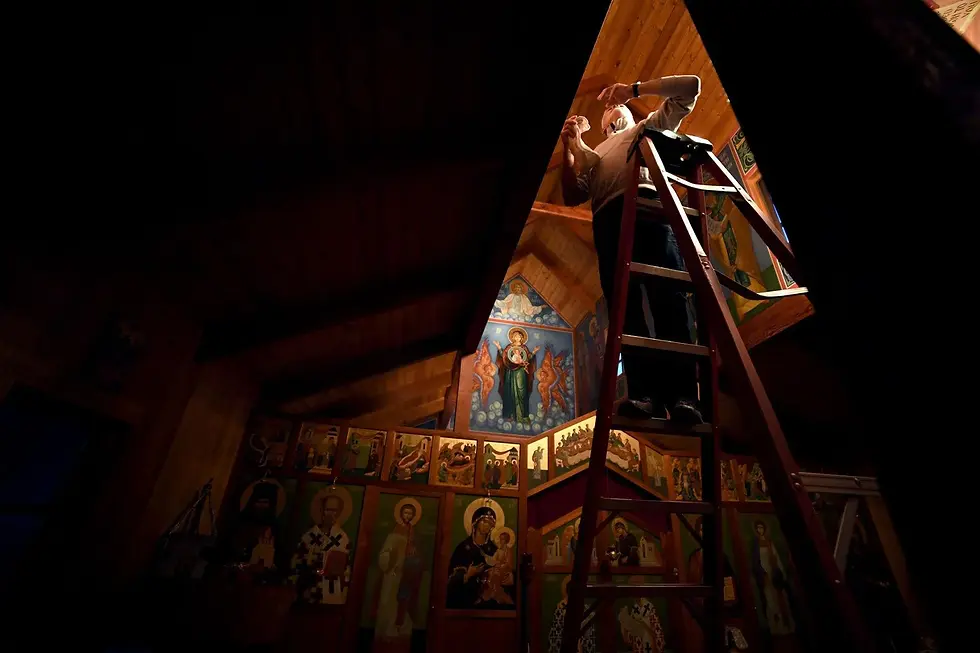
After the church’s technical completion in 2001, it was not for another 15 years until its paintings and frescoes were finally complete, having the torch of artist being passed through three individuals: Russo-Canadian artist Mother Anastasia, American artist Mark Hrebinka, and finally Ukrainian-Canadian artist Alexander Koutsenko.
This is where the true beauty of the parish lies, not in its frescoes, but instead in those who helped make them.
“Our parish composition is everything,” Father James said. “We do have some people who were born Orthodox, émigrés from the old-country, people from the Ukraine, from Russia, Serbia, Greece, what-have-you.”
Out of these émigré families, many are mixed Russo-Ukrainian households who have been displaced by the war in Eastern-Europe. “Our position on the war is ‘peace,’ we think it's a horrible tragedy,” Father James continued. “The jurisdiction of which we are a part of (the Russian Orthodox Church Outside Russia, headquartered in New York) is the largest not-for-profit donor of humanitarian aid to the Ukraine.”
“Most of our people are native-born Amerians who did not start out in the Orthodox Church. They found it on their way to our confession at some point in their lives, they felt that it was where they wanted to be… At least three-quarters of this parish are American-converts,” Father James said.

Moses is one of these American-converts, living the life of an Evangelical upbringing, wandering from varying Protestant denominations throughout his life before finally coming to Orthodoxy a few years ago.
“Before I came here there was a lot of soul searching,” Moses said. “I was raised in many different Evangelical churches, I was raised Methodist, spent a lot of time in Baptist churches, very ‘fire and brimstone.’ I got this sinking feeling, wondering ‘how close am I to the history (of the church), how close am I to my contemporaries from 2,000 years ago?’ If the apostles came back today and went into your church, what would they think?”
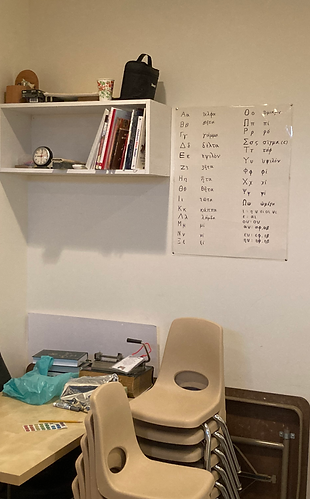
Picture of a desk in the Sunday school room. Featuring Cyrillic alphabet on the wall.
“One thing that was very inspiring (to me) was the children, all the children are participating (in) the veneration of the icons, the kissing of the cross, taking communion, and singing. All the children are involved in some way shape or form, nobody’s left out. Nobody is going to be judged if they make a mistake. Here, I came and everyone really took the time to explain where they were coming from or what things mean. When it came to the human side of it, everyone was way more relaxed.”
For Moses the detraction of modern Christianity from traditional worship left him with a yearning for something deeper, something he felt was missing in his upbringing. Upon discovering Orthodoxy, he found the purpose he was searching for in tradition.
“I was living in Corvallis at the time when I first inquired, and even after moving out and being far away, I still found means to try and come (here) because this was the closest I could find to any historical expression.”
Out of those who have worked so hard and dedicated their life to preserving the Orthodox tradition, is Father James’ wife, Nina Baglien, who in Orthodox tradition is referred to as "Matushka,” which roughly translates to “little mother.”
Nina’s role acts much like her title entails, she plays a motherly role for those in the parish, looking after, taking care of them and prepping food for the trapeza (or reflectory)—which is a traditional dining hall service after fasting and liturgy, where members of the church gather food and conversation.
“I oversee everything surrounding parishioners and what they need as the services go on and I support Father James in whatever extra things he may need me to do,” Baglien continued. “It is exciting to see people come, to help them with their needs, to support their spiritual endeavors, and try to channel them in the right direction.”

The heads of visitors and official church members alike are bowed in prayer during a service.

Martinian, a subdeacon and member of the minor clergy, or is as he puts it, “an older brother in a big family.”
As a subdeacon and minor clergyman, Martinian does not have large authority, but he does have the blessing of the upper clergy to read during liturgy or serve at the altar.
“If a bishop were to come I would be like his right hand man.” Martinian further explained.
A woman lighting a candle and venerating icons. Chanting can be heard throughout the video.

Father James standing before the tabernacle.
According to Martinian the minor clergy do not need any extra education, in-fact, in modern times most of the jobs that would fall under his title are done by just normal members of the church.
“The monastery I first visited—their mission was translating the Russian books into English, and that's why people (say that they) didn’t know anything about it (the Orthodox Church). It's because for many years it didn’t exist for many people (in America).” Martinian said.
During liturgy—if Martinian was reading—he would approach the cliros (reader stand), where he would lead the chanting and singing.
“Reading at (the) cliros is part of your duty, the book setup, the order of the services—which is fairly complicated—once you have been doing services for thousands of years and different countries do it slightly differently and to make sense of it you need some education—not formal (education) your priest would teach you.”
Martinian was raised in a traditionally Protestant Christian environment. When he was nine he moved from Massachusetts to California and there he was introduced to Orthodoxy via a friend of his mother, who was a member of the local Orthodox monastery. Now, Martinian has been part of the Orthodox Church for over 40 years.
“I first walked into an Orthodox Church when I was nine, and it floored me,” Martinian said.
Martinian described his experience with the Church’s teachings as being given a toolbox, and the Protestant toolbox used by modern America is a much more limited, stripped down version of the toolbox used in Orthodoxy.
Seeing as Protestantism values the Bible above all other teachings, it misses some of the crucial values given through tradition and history. “Orthodox Christians are not better (than non-Orthodox Christians), but we’re better off,” Martinian said. “We have the full toolbox.”

Paintings of Saints look down at those below. Each Saint holding a symbol of Christ.
In explaining his time in Orthodoxy, Martinian said, “I was being taken care of and I was being seen in life, which I had never had before… loving me without being weird… (in Protestantism) there is this fake love, it's not people being evil… but they are faking it till they make it so to speak.”
“Where other forms of Christianity evangelise through ‘spreading the word,’ we (the Orthodox Church) take a ‘come and see’ approach, where we wait for those seeking us to come and find us,” Martinian said. “We very much want people to find us. Whether or not they find their home with us—that is a personal decision,” Father James added.
“Where other traditions are a flower, this is a bouquet.” — Nina Baglien